
God is Simple
A remarkably complex thing I need to remember.

The other day I shared a quick thought with our volunteers at church, during what we affectionately call our pre-service “rally”.
It’s the kind of thing that is meant to be a simple biblical encouragement, but because I can never leave well enough alone, when it’s my turn to share, it sometimes becomes a small theological rabbit hole that I drag everyone down into with me.
In any case, we have been talking through the fruit of the Spirit, going aspect by aspect through that passage in Galatians, and my assignment was faithfulness.
Here’s a quick reminder in case you’ve forgotten your Sunday School training: “But the fruit of the Spirit is love, joy, peace, patience, kindness, goodness, faithfulness, gentleness, self-control; against such things there is no law” (Galatians 5:22-23).
Side note: the nine items are one fruit—singular by the way—which is its own little grammatical sermon if you have time for it, and I always do, so everyone got it whether they wanted it or not.
I digress. Here’s the point: understanding God’s faithfulness is very different than how we would understand a person’s. This is because faithfulness is not simply an act of what God does, but an attribute of who he is.
This creates a problem. Because we measure the faithfulness of people by the track record they have.
For example: I said I would take out the trash and I didn’t, so a small demerit gets quietly filed in the marital accounting department—which doesn’t exist (probably).
People’s faithfulness can range from all the little things like this all the way to our major blunders. So when I falter, even to a degree, am I now unfaithful? Well, to be entirely truthful. Yes. I am only considered faithful because of what I do or do not do. It’s not innate to my nature as a person. That’s not an excuse, just a fact.
Why? Because, unlike God, I am not SIMPLE. (At least, not in the way you probably think).

The old theologians had a phrase for this deep reality of who God is, and at first, it sounds like a compliment you’d give a golden retriever. In classical terms, it’s called the simplicity of God.
God’s Simplicity has nothing to do with him being dumb, let alone easy to understand, which, you know, he is famously the opposite of. It means God is without parts. He is uncompounded, unassembled. In other words, not the sum of many things.
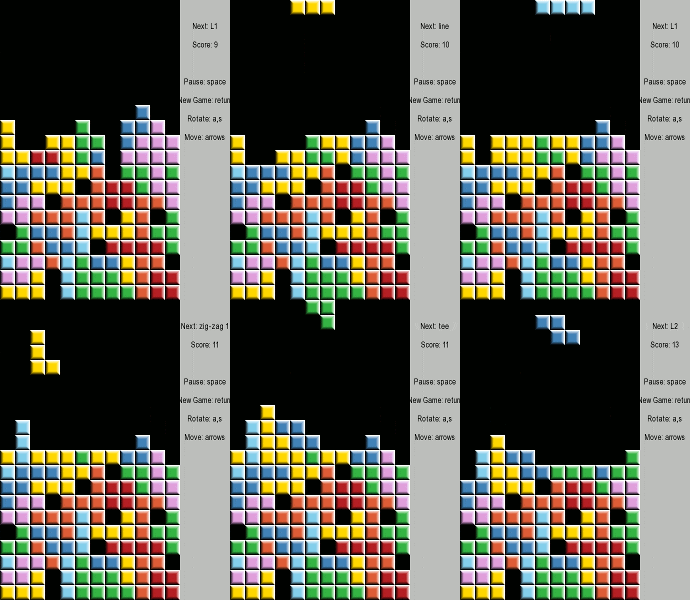
Like all of God’s attributes, God is them in totality. That is to say, God isn’t a Tetris board made up of all these different shapes of attributes: like a little bit of love, and grace, and faithfulness, and when you combine them, you get God. That’s not who He is. And this breaks our brains a little.
You and I, on the other hand, are composites. We are the sum of many things, including our propensity to change, both in the negative and in the positive.
God is nothing like that. He is fully and equally all of his attributes simultaneously. If you can fathom it, his love is his justice is his mercy is his faithfulness, all the way through, with no seams and/or percentages of these. So when Scripture says God is faithful, it means faithfulness is simply what it is like when God is being God.
A.W. Tozer once wrote about this: Whatever God is, He is. When we talk about the unity of God and His attributes, we sometimes think of all of the parts of God working together harmoniously. That is an inadequate picture of God. God is not made up of parts. God is God.
And of course, Israel already had the shorthand theology for this, way back in the desert days: “Hear, O Israel: The LORD our God, the LORD is one. You shall love the LORD your God with all your heart and with all your soul and with all your might” (Deuteronomy 6:4-5).
The LORD is one, and undivided. And notice the response the Shema demands of us as well: all our heart, all our soul, and all our might. An undivided God requires undivided people. Which is precisely the problem, because I am divided the way a garage sale is divided: mostly one man’s trash and maybe some parts another man’s treasure. My love is divided and my faithfulness falters. I can make a good choice and a bad decision, and sometimes in the same breath.
So what are we supposed to do with all this?
We can never measure up to that kind of faithfulness God actually is. In other words, the gap between a God who is faithful and a person who mostly means well is the kind of gap you measure in light-years.
Here is what I think we ought to do: Strive for faithfulness, absolutely, and also remember that direction is key when exactness misses the mark.
There’s a proverb that can really give some peace in the middle of our lacking faithfulness: “for the righteous falls seven times and rises again, but the wicked stumble in times of calamity” (Proverbs 24:16).
Notice the righteous man in that verse falls. Seven times, as a Hebrew idiom, basically means constantly. It means this guy is on the ground so often that he should list it as his address. What separates him is that he rises again. He keeps getting up, keeps walking the narrow road of faithfulness to God and to the people God has given him. He misses the mark on exactness but stays on track in direction.
In that way, I think this is all we can do. I am not “faithful” innately. It’s a daily decision. Not so for the Lord. He doesn’t choose to be faithful. He simply is.
Though I am required to be “holy” or “perfect” as the Lord is, I am not. And so, like all the many Londoners who board their trains every day in their commutes, we must simply “mind the gap”.
FYI, the intercom literally says the phrase repeatedly as people pour out of the steel traps of these carriages.
My brother Andrew has often reminded me of a famous Thomas Merton prayer from Thoughts in Solitude that may just bless you:
”My Lord God, I have no idea where I am going. I do not see the road ahead of me. I cannot know for certain where it will end. Nor do I really know myself, and the fact that I think that I am following your will does not mean that I am actually doing so. But I believe that the desire to please you does in fact please you. And I hope I have that desire in all that I am doing. I hope that I will never do anything apart from that desire. And I know that if I do this you will lead me by the right road, though I may know nothing about it. Therefore will I trust you always, though I may seem to be lost and in the shadow of death. I will not fear, for you are ever with me, and you will never leave me to face my perils alone.”
The good news is that the undivided One stays faithful to his little divided ones, and every time we get back up, his simplicity is there… with a faithfulness that is steadfast, even in our mess.
This Psalm is a great addition to this scrambled egg of ideas I’m trying to give you:
13 As a father has compassion on his children,
so the Lord has compassion on those who fear him;
14 for he knows how we are formed,
he remembers that we are dust.
15 The life of mortals is like grass,
they flourish like a flower of the field;
-Psalm 103:13-15 NIV
So, my encouragement is simply this: keep on walking. I believe the desire to please him does, in fact, please him.
-Jeremiah
🙌